Color as a Material
PRODUCTORA
Architecture Magazine EN BLANCO, Nº 39 - PRODUCTORA, 2025
Publishing allows us to rethink, reorganize, and redefine the studio’s work. In this case, the publication compiles a series of projects created between 2017 and 2025 in which concrete plays an important role, and also adds a new project that will begin construction in early 2026. As a raw material, concrete makes countless variations and possibilities: it allows to experiment with the type of cement, sand or aggregate used in the mixture, there are unlimited options in formwork design, and a range of possibilities for final finishes such as washing, polishing, hammering, brushing, oxidizing, sealing, etc. In recent times, the notion of color has been added to this infinite range of possibilities, by adding pigments in gel or powder form to the mixture. All the projects presented here use some type of color in the concrete mix. There are shades that mimic the color of local sand or earth (Hotel Kymaia and the Teotitlán Community Centre and Museum) or dry grass before the rainy season turns it back into an explosion of green (Teopanzolco Cultural Centre), the color of water and sky (Bautista House), or, conversely, a color that contrasts with the green of the surrounding environment (Casa Rosada).
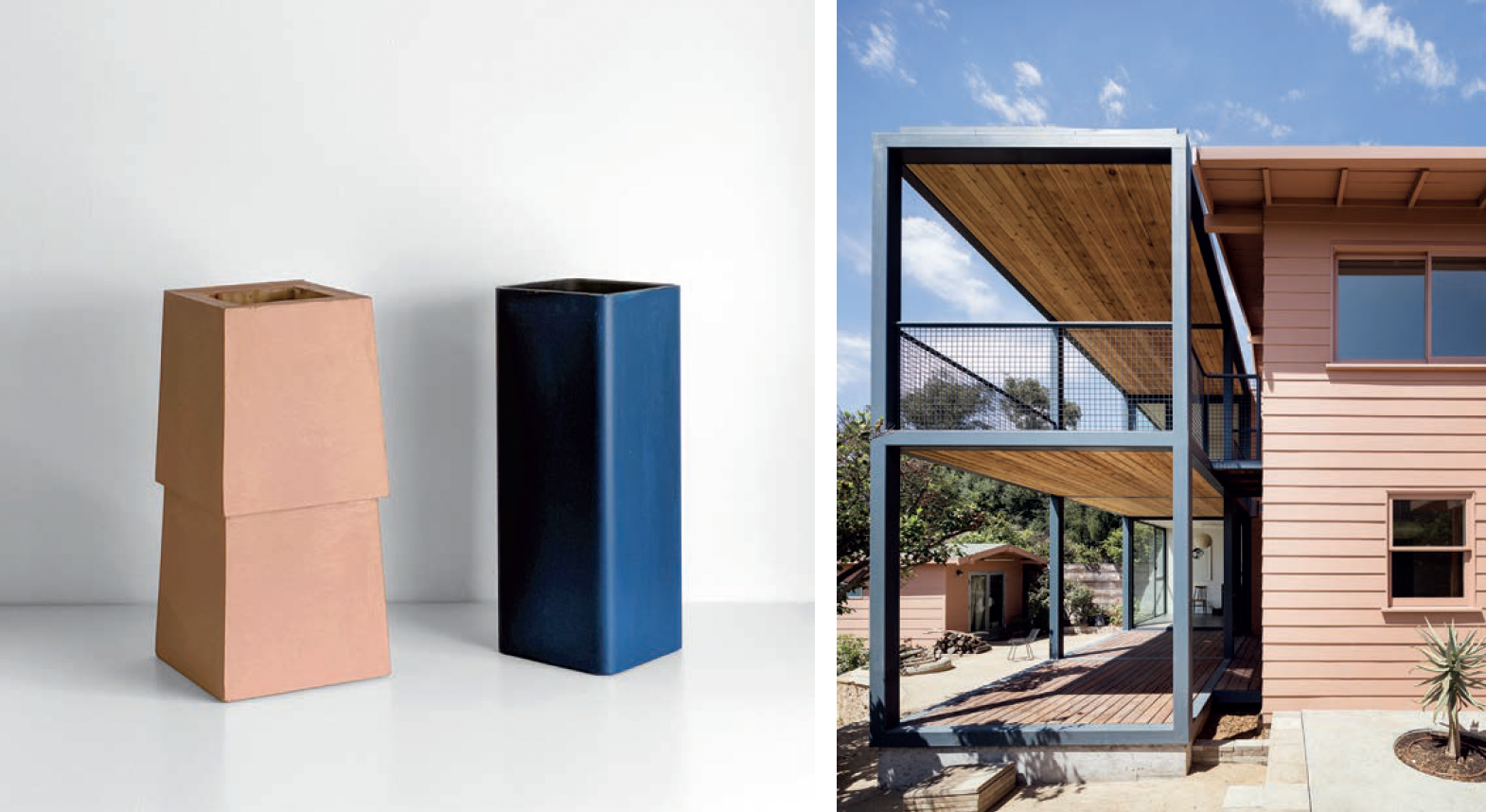
And although architecture in Mexico is closely linked to color, due to the legacy of Pritzker Prize winner Luis Barragán, at PRODUCTORA we did not explore the theme of color in architecture until we began working on projects in the United States. While in Mexico we could use the appearance of the material itself (natural stone, wood, concrete, tile, etc.) to obtain certain textures, sheen and colors, in the United States we were confronted with materials that demanded a finish and, therefore, a decision on their color scheme: metal roofing, fiber cement cladding, etc. The house for Jessica Fleischmann in Los Angeles was key to understanding this change in the design process. We were fortunate that the owner was a graphic designer, and together with her we began to work on the color palette, matching materials with different shades: we decided on Dunn Edwards’ Foxtail color for the existing wooden structure and Night Blue for the added steel structure. This experience of working more consciously with color was repeated shortly afterwards in Mexico, where we applied blue concrete to the Bautista house.
However, it is important to understand that in our architecture, color does not play a compositional role as it does in the projects of Le Corbusier, Alvar Aalto or Barragán, for example. Aalto’s use of color in the Paimio Sanatorium (together with his wife Aino Aalto and the artist Eino Kauria) is ultimately pictorial and compositional, even though he uses a certain functionality – color theories based on scientific and emotional interpretations – to argue his choices. Le Corbusier also defines color as an additional layer to accentuate, untangle and classify. For us, paint is like any other material. It is simply a material that comes with an unlimited range of hues. We mostly only use one shade in each project, almost always to cover materials that cannot exist without protection, such as metal features. By selecting strong colors, the material takes on a specific character in each project, such as the yellow shelving in the studio in Soho, New York, the green metalwork in Laguna, or the red metalwork in the CA22 housing project. Color as a notational system; as an index of both a material and conceptual stance.
As in Punta Nayaá tourist complex, which consists entirely of a latticework of prefabricated green concrete blocks (which over time are dissolved by the vegetation that intertwines with them), the pink prismatic elements in the urban parks of Tultitlan and Tlanepantla on the outskirts of Mexico City, or the projects represented in this edition, concrete no longer consists of a greyish mass, but we understand it as a material that requires a precise definition of its color. Working with mass-colored concrete allows color to be applied as a material in the most literal sense possible: in these projects, liquid color solidifies and transforms into pure matter.